
Legendary Football Shirts: Beckham, Ronaldinho, Gerrard & Romário’s 1994 Magic
Updated: Aug 18
Introduction
Football shirts are far more than performance garments—they are cultural artefacts, markers of identity, and storytellers of eras shaped by unforgettable players. The collection of shirts presented across the text embodies nearly three decades of football history, spanning continents, generations, and stylistic evolutions in the sport. From legendary national team kits to iconic club shirts worn during pivotal seasons, each piece reflects a unique convergence of sporting achievement, cultural resonance, and personal legacy. This compilation brings together extraordinary narratives ranging from Cristiano Ronaldo’s prolific years at Juventus to Steven Gerrard’s rise at Liverpool, Romário’s dominance with Brazil, and the emotional renaissance of Marseille through the brilliance of Luiz Gustavo and Florian Thauvin.
These shirts carry the weight of defining football moments. Some represent seasons of domestic triumph, such as Juventus’ ninth consecutive Serie A victory or Manchester United’s 2002–03 Premier League title. Others capture the identity of national teams during major international cycles, like Italy’s post-World Cup era under Cannavaro’s leadership or Cameroon’s continental presence with Samuel Eto’o as their talisman. Some shirts mark transitional chapters—Gerrard’s formative number 17 years at Liverpool, Ronaldinho’s explosive European introduction at PSG, or Benfica’s European knockout run of 2006–07. Still others, like Arsenal’s 2008–09 away shirt, highlight a blend of youthful leadership and European ambition.
Collectively, these shirts reflect the evolving aesthetics of football apparel. They chart the shift from the classic bold designs of Umbro’s Brazil shirts to the streamlined silhouettes developed by adidas and Nike in the 2000s and 2010s. They show how modern kits increasingly balance tradition with innovation: Juventus adopting unconventional colours, Marseille blending heritage with contemporary styling, and national teams embracing sleeker fits that mirror modern athletic demands.
But above all, this ensemble tells human stories—stories of captains, playmakers, goalscorers, and leaders. We revisit Gerrard’s transformation into Liverpool’s heartbeat, Ronaldo’s relentless pursuit of records, Del Piero’s elegance during Italy’s transitional years, and Eto’o’s embodiment of Cameroonian excellence. We also see the emergence of rising stars such as Hirving Lozano, Maxime Lopez, or Thauvin during defining seasons for their clubs or countries.
For collectors, this compilation highlights why shirts become treasured objects: they immortalise emotions, preserve moments of greatness, and offer tangible connections to the players who shaped the sport. Every shirt here carries a narrative of ambition, resilience, or triumph, making the collection not only visually compelling but historically rich.
This introduction frames the broader significance of all the shirts discussed—a mosaic of football heritage, personal legacies, and the timeless power of sporting memory.
Summary
Across the entire body of text, the collection of shirts forms a comprehensive journey through some of football’s most defining eras. Each shirt corresponds to a meaningful chapter in the careers of celebrated players or to essential moments in the history of their clubs and national teams. Collectively, they represent an evolution of football culture, aesthetic trends, and sporting achievements.
The Juventus 2019–20 away shirt symbolises a season shaped by Cristiano Ronaldo’s extraordinary scoring output and the club’s continued Serie A dominance. The Liverpool shirts—one from Gerrard’s maturity as captain and another from his earlier years wearing number 17—document his development from promising midfielder to generational leader. The Mexico 2018–19 shirt with Chicharito celebrates national pride and the enduring legacy of Mexico’s all-time top scorer.
The Italy shirts provide two distinct perspectives: Cannavaro’s era captures the glow of post-World Cup excellence, while Del Piero’s 2003–04 kit reflects a period of transition and refinement within the Azzurri squad. Eto’o’s Cameroon away shirt highlights African football identity and the star power of one of the continent’s greatest performers. The Brazil 1994–95 Romário shirt stands as an unmistakable global icon, recalling both a World Cup triumph and one of the most dominant individual campaigns in football history.
The club-level shirts also illustrate unique turning points. Benfica’s 2006–07 shirt marks a season of European progress and the emotional leadership of Rui Costa. Marseille’s training kit from 2016–17 represents a rebuilding phase that reshaped the club’s ambitions, while the 2017–18 shirts for Luiz Gustavo and Thauvin capture a spirited Europa League run and a revitalised Marseille identity. Ronaldinho’s 2001–02 PSG home shirt documents the arrival of an artist who would go on to redefine football entertainment. Beckham’s 2002–03 Manchester United third shirt signals the end of an era and a final title-winning campaign before his departure to Real Madrid. The Arsenal 2008–09 away shirt with Fàbregas marks a season of youth-driven ambition and European achievement.
Throughout these narratives, recurring themes emerge: leadership, identity, evolution, and emotional connection. Many shirts represent seasons of competitive success, but others capture transitional or foundational moments that shaped future eras. Together, they represent how football shirts function as historical documents, capturing not only results but moods, transformations, and the personalities that defined them.
For collectors, the value of this ensemble lies in the authenticity of each shirt’s story. Rare early-career shirts, kits linked to major tournaments, shirts worn during captaincies or scoring peaks—all carry strong emotional and historical weight. The entire text conveys why such shirts endure: they allow supporters to relive defining goals, unforgettable atmospheres, and the rise or permanence of footballing legends.
2002-03 – Real Madrid – Centenary Home Shirt - Zidane 5 - M

The 2002–03 Real Madrid Centenary Home Shirt with Zidane’s number 5 is one of the most recognisable and historically significant shirts in world football. Worn during a season that celebrated the club’s 100th anniversary, the shirt became a symbol of both Real Madrid’s extraordinary legacy and the brilliance of a squad often referred to as the first true “Galáctico” era. For supporters and collectors, the shirt represents a rare intersection of sporting success, iconic design and one of Zinedine Zidane’s finest seasons with the club.
By the time the 2002–03 campaign began, Zidane had already established himself as one of the best midfielders on the planet. His arrival at Real Madrid in 2001 had added an unprecedented layer of artistry to a team already rich with world-class talent. Wearing the elegant number 5 shirt—an unusual number for an attacking midfielder—Zidane continued to redefine his role, blending vision, positional intelligence and technical mastery. His ability to dictate the tempo of matches, break defensive lines with subtle movements and deliver world-class goals made him central to Real Madrid’s identity.
The centenary season holds special significance because it coincided with one of the strongest squads ever assembled. Ronaldo Nazário joined the team and instantly became a decisive force in attack. Raúl contributed leadership and goals in key moments. Figo remained one of the world’s best creators on the right flank, while Roberto Carlos added extraordinary energy and long-range precision. Behind them, Makélélé provided balance and stability, while Casillas continued his emergence as one of Europe’s most promising goalkeepers. Together, this group formed a team that blended personality, talent and tactical intelligence.
Throughout the 2002–03 season, Real Madrid showcased some of the most attractive football in Europe. The team won La Liga, finishing above strong rivals and demonstrating consistency across a demanding campaign. Zidane’s performances were central to their success: his assists, long-range strikes and control of midfield spaces left lasting impressions on supporters and opponents alike. Several matches from this season remain vivid in fans’ memories due to the team’s fluidity and attacking brilliance.
From a design perspective, the centenary home shirt is unique in the club’s history. Its clean white foundation pays homage to Real Madrid’s traditional identity, while subtle gold accents and commemorative touches highlight the club’s 100th anniversary. The minimalist aesthetic became a symbol of prestige, tradition and excellence. When paired with Zidane’s number 5, the shirt becomes even more striking, representing both a legendary player and a milestone season.
For collectors, the shirt’s appeal is immense. Centenary kits are naturally limited in their historical context, and those associated with major trophies or iconic players gain additional value. This particular shirt combines all three: a rare commemorative design, a La Liga title and Zidane at the height of his elegance. Finding an original piece in size M and very good condition makes it especially desirable.
For Real Madrid supporters, the shirt evokes memories of creativity, star power and moments of pure footballing artistry. It symbolises a celebration of the club’s heritage and the influence of one of the greatest players ever to wear the white shirt. Whether displayed, preserved or worn with pride, the 2002–03 Zidane 5 centenary home shirt remains a timeless tribute to a historic era.

2002-03 – Real Madrid – Centenary Home Shirt - Raul 7 - XL

Few football shirts capture the weight of history, the brilliance of star players and the emotion of a defining season quite like the 2002–03 Real Madrid Centenary Home Shirt with Raúl’s iconic number 7. Made for the club’s 100th anniversary, this shirt stands as one of the most memorable in Real Madrid’s long story, symbolising both heritage and excellence. For collectors, fans and football romantics, it represents a golden era in which skill, personality and results aligned on the biggest stages.
The 2002–03 season itself holds a special place in Real Madrid folklore. Celebrating their centenary year, the club entered the campaign with a squad that could only be described as extraordinary. With Raúl leading the line and wearing the captain’s armband in many matches, Madrid also boasted Ronaldo Nazário, Zinedine Zidane, Luís Figo, Roberto Carlos and Guti—names that defined an era and elevated the team’s global prestige. These were players who blended individual brilliance with collective strength, offering moments of football that many fans still recall vividly.
Domestically, Real Madrid delivered. At the end of the La Liga season, the club finished in first place, securing the league title by a narrow two-point margin. Their campaign showcased consistent quality, tactical intelligence and the attacking flair that supporters strongly associate with that era. Raúl contributed not only through goals and assists but through leadership, intensity and an unshakeable sense of belonging to the shirt. For many fans, he was the embodiment of Real Madrid during this period—a symbol of continuity during a time of star-studded glamour.
The Centenary home shirt worn that season captured these emotions in its design. Retaining the pure white that defines Real Madrid, it incorporated subtle commemorative elements honouring the club’s 100 years of existence. The style was elegant yet understated, paying tribute to the club’s identity rather than overshadowing it. When seen on the pitch, the shirt carried a sense of ceremony: every match in it felt bigger, every moment more historic.
For collectors today, the shirt holds exceptional appeal. Original 2002–03 Centenary home shirts, especially with the Raúl 7 print in size XL, have become increasingly scarce. Age, limited production and the natural loss of older shirts over time mean that surviving examples in very good condition are genuinely valuable items. This shirt represents not only a key season but also a milestone in the club’s timeline, making it a piece with both aesthetic and historical significance.
Among fans, the shirt still resonates because it connects them to a period defined by both emotion and achievement. It recalls La Liga triumphs, long-range goals, skilful interplay and unforgettable nights in front of passionate supporters. It marks a chapter where some of the greatest players of all time shared the same colours. And above all, it reminds supporters of Raúl—a living emblem of Real Madrid’s values—leading a team known worldwide for its collective talent.
Whether displayed on a wall, preserved in a collection or worn with pride, the 2002–03 Centenary Home Shirt with Raúl 7 remains a treasured piece of football heritage. It embodies tradition, success and identity in equal measure, making it one of the most sought-after shirts from Real Madrid’s modern era.

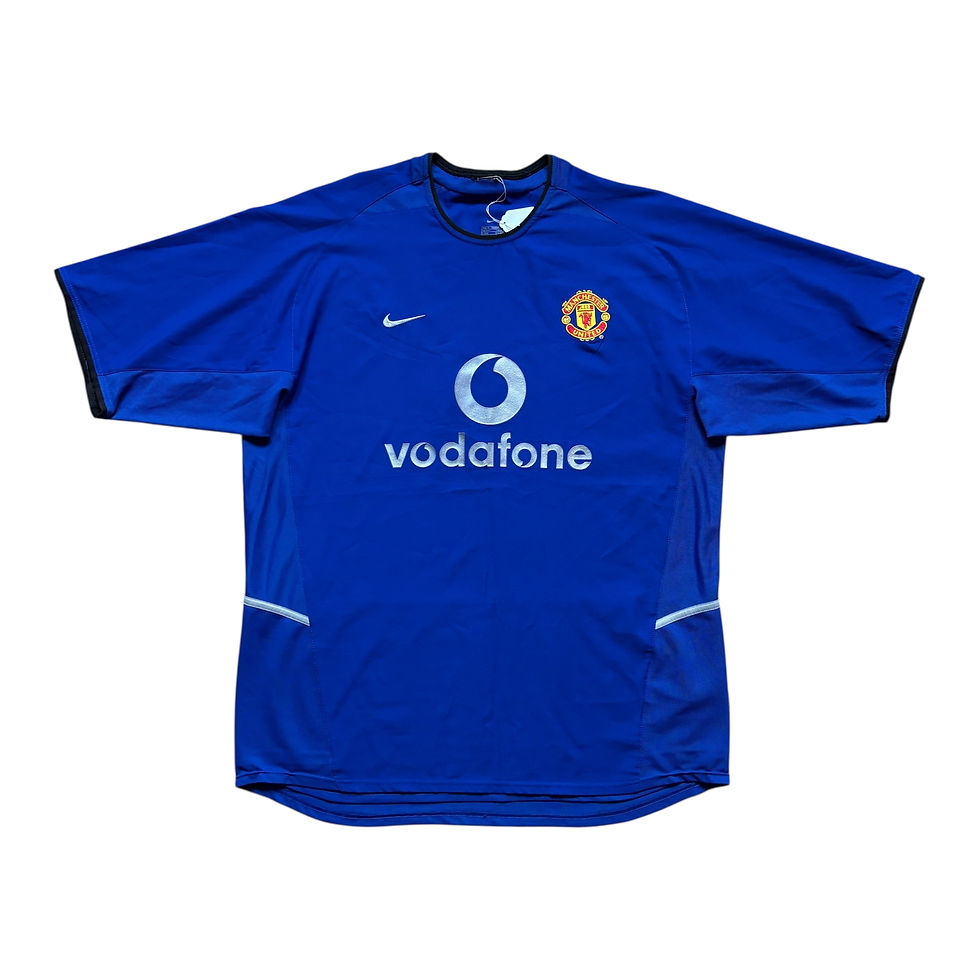
2002-03 - Manchester United - Third Shirt - Beckham 7 - XL

The 2002–03 Manchester United Third Shirt with Beckham’s iconic number 7 is a piece of football history that encapsulates both sporting success and the end of an era. Produced by Nike, this shirt carries enormous cultural and emotional weight for fans, as it represents David Beckham’s final season at the club he helped define for over a decade. For collectors, supporters and football historians, few shirts capture a moment in Manchester United’s story as powerfully as this one.
The 2002–03 season was eventful and ultimately triumphant for Manchester United. After trailing Arsenal for much of the campaign, United produced a strong late run that propelled them to the Premier League title. This victory marked the club’s eighth Premier League triumph under Sir Alex Ferguson, reaffirming their dominance in English football during the late 1990s and early 2000s. United’s campaign was driven by the relentless goalscoring of Ruud van Nistelrooy, the creativity of Paul Scholes, the leadership of Roy Keane and the technical quality provided by Beckham, Giggs and others.
For Beckham, the season holds particular importance. It became his last in United colours before joining Real Madrid in the summer of 2003. Despite injuries and media attention surrounding his relationship with the manager, Beckham remained a decisive contributor. His set-piece delivery, crossing accuracy and tactical intelligence continued to influence major matches. Fans remember this season as the closing chapter of Beckham’s legendary association with the number 7 shirt—a number worn previously by icons such as George Best, Bryan Robson and Eric Cantona.
The third shirt worn that season carries its own visual and historical significance. Third kits are typically used less frequently, which adds to their rarity and desirability among collectors, and the 2002–03 version is no exception. Its design, colours and feel are closely associated with United’s European nights and alternate-strip fixtures in domestic competitions. Wearing Beckham’s name and number, the shirt offers a direct link to moments that defined the club’s identity: attacking football, dramatic comebacks and world-class individual performances.
In today’s collecting world, original Beckham 7 shirts from the 2002–03 season—especially in size XL and in strong condition—have become increasingly hard to source. Age, limited use of the third kit and the growing interest in Beckham memorabilia contribute to the rarity of authentic examples. This elevates the shirt not only as a piece of sporting apparel but as an investment in football heritage. Collectors place particular value on shirts from a player’s final season at a club, and Beckham’s departure for Madrid makes this item even more historically relevant.
Beyond collectability, the shirt resonates emotionally with fans. It symbolises a period of transition and success: a title-winning campaign, the farewell of an icon, and the continuation of United’s attacking tradition. For supporters who lived through the era, the shirt brings back memories of Beckham’s free-kicks, van Nistelrooy’s goals, and the unity of a squad driven by Ferguson’s unyielding ambition. For newer fans, it represents a vital chapter in the club’s story—one that shaped Manchester United’s global identity.
Whether worn proudly, framed for display or kept as a treasured item in a collection, the 2002–03 Manchester United Third Shirt with Beckham 7 remains a meaningful and enduring symbol of the club’s history.
1997-99 - Manchester United - Away Shirt - Beckham 7 - L

The 1997–99 Manchester United Away Shirt with David Beckham’s iconic number 7 is one of the most meaningful and collectible shirts in the club’s history. Produced by Umbro, the shirt represents not only a distinct design era but also one of the most successful and emotionally charged periods the club has ever experienced. This shirt is forever linked to Manchester United’s Treble-winning campaign of 1998–99—a moment that sits at the pinnacle of English football history—and to Beckham’s rise as one of the most recognisable and influential footballers in the world.
These two seasons marked Beckham’s complete ascent from promising young midfielder to global superstar. Wearing the number 7, a shirt previously graced by legends such as George Best, Bryan Robson and Eric Cantona, Beckham embraced both the responsibility and the legacy attached to it. His performances during this era were defined by extraordinary consistency: pinpoint crosses, long-range passing, tireless running and a maturity that belied his age. The image of Beckham delivering inch-perfect balls onto the heads or feet of teammates remains one of the enduring visuals of Manchester United’s late-1990s dominance.
The 1998–99 season itself is historic. Manchester United achieved the Treble by winning the Premier League, FA Cup and UEFA Champions League—all within the same campaign. Very few clubs in world football have matched this accomplishment. Beckham played a central role in United’s success, finishing the season among Europe’s top assist providers and contributing decisive performances across competitions. His corners and crosses became essential weapons in United’s attacking arsenal, especially in the Champions League, where delivery from wide areas often sparked crucial goals.
Surrounded by players who would become club legends—Giggs, Scholes, Keane, Yorke, Cole, Neville, Stam and Schmeichel—Beckham thrived in a team that embodied intensity, creativity and tactical intelligence. Under Sir Alex Ferguson, United played with a fluid and fearless style, often overpowering opponents with speed and collective movement. Beckham’s technical precision and competitive spirit made him invaluable to this approach.
From a visual perspective, the 1997–99 away shirt holds a special place in football culture. The crisp white base paired with navy and red accents created a sharp and elegant look consistent with Umbro’s design philosophy of the late 1990s. The shirt was used across domestic and European fixtures and quickly became associated with some of the era’s most memorable performances. When combined with Beckham’s number 7, it becomes an item deeply embedded in nostalgia, recalling an era when Manchester United ruled English football and conquered Europe.
For collectors, this shirt remains one of the most desirable Manchester United pieces of the modern era. Shirts connected to the Treble season carry significant emotional and historical value, and Beckham’s involvement only amplifies that appreciation. In size L and very good condition, it is a standout piece suitable for display or careful wear. It embodies not only the triumphs of the team but also Beckham’s impact on football culture, fashion and global sports identity.
To supporters today, the 1997–99 Beckham away shirt serves as a reminder of determination, excellence and unity. It symbolises unforgettable nights, last-minute goals and the sense that a group of players could achieve anything together. It is more than a shirt—it is a representation of a golden era.

2008-09 – Arsenal – Away Shirt – Fabregas 4 - L

The 2008–09 Arsenal away shirt featuring Cesc Fàbregas and his iconic number 4 is a standout piece for collectors and supporters who appreciate the significance of Arsenal’s transitional years. Manufactured by Nike, the vivid yellow-and-navy design is instantly recognisable and ties directly to one of the club’s most defining modern seasons—a period in which leadership, youth development and European ambition converged.
Arsenal entered the 2008–09 campaign with both optimism and pressure. While the squad contained exceptional talent, inconsistency and injuries shaped their early form. A pivotal moment arrived in November 2008 when Cesc Fàbregas was appointed club captain. At only 21, he became the youngest permanent captain in Arsenal’s history at the time. His creativity and maturity made him the natural focal point of the team, and the away shirt with his Champions League nameset captures the essence of that responsibility.
On the pitch, Arsenal’s season featured memorable highs. The club finished 4th in the Premier League with 72 points—securing another year of Champions League football. Their European campaign was even more impressive. Arsenal reached the semi-finals of the UEFA Champions League, overcoming strong opposition along the way. Although they ultimately fell short of reaching the final, their run remains one of the highlights of the late-2000s era. The squad blended youthful energy with established experience: Robin van Persie provided goals and technical brilliance, Samir Nasri and Theo Walcott injected creativity and pace, while players such as Kolo Touré and Emmanuel Adebayor added strength and presence.
The away shirt itself carries strong visual and emotional resonance. Arsenal have a long tradition of yellow away kits, and this version paid homage to that heritage. The colour scheme not only stood out during domestic and European matches but also linked the modern team to the club’s historical identity. Supporters often associate this shirt with moments of spirited performances, late-night Champions League fixtures and the sense of hope that the young squad generated despite their inconsistencies.
For collectors today, the 2008–09 Fàbregas away shirt is increasingly difficult to source in good condition, especially with the official Champions League nameset. Authentic examples are now sought after because of their age, limited production and the strong emotional connection fans have with that season. A size L in very good condition is particularly appealing, as it remains wearable while also suitable for display.
What makes this shirt matter to fans now is the story it tells. It reflects an era when Arsenal were evolving, attempting to build a new identity grounded in technical excellence and youthful leadership. It recalls a captain stepping into responsibility, a squad pushing deep into Europe and a fanbase united by belief in the team’s potential. Whether framed, collected, or worn with pride, the Fabregas 4 away shirt remains a symbol of resilience, ambition and a memorable chapter in Arsenal’s modern history.
2001-02 - Paris Saint-Germain - Home Shirt - Ronaldinho 21 - L

The 2001–02 Paris Saint-Germain Home Shirt with Ronaldinho’s number 21 is a cherished piece of football history, marking the Brazilian star’s first season in Europe. Produced by Nike, the shirt represents the beginning of Ronaldinho’s ascent from a promising South American talent to one of the most influential players of his generation. For kit collectors and football enthusiasts, this shirt carries both cultural and historical significance.
Ronaldinho arrived in Paris in the summer of 2001, joining PSG at just 21 years old. Expectations were high, as his performances for Grêmio and the Brazilian national team already hinted at extraordinary potential. In his debut season, he quickly became the club’s main creative force. His dribbling, improvisation and ability to produce moments of magic drew widespread attention throughout France and Europe. Wearing the number 21 shirt, he introduced fans to the trademark style that would later make him a global icon: dazzling footwork, joyful expression and the ability to turn matches with a single touch.
PSG’s 2001–02 season was a mix of individual brilliance and collective inconsistency. The team finished mid-table in Ligue 1, lacking the stability needed to challenge for the title. Yet their attacking flair was undeniable, shaped not only by Ronaldinho but also by players such as Jay-Jay Okocha, Mikel Arteta, Nicolas Anelka and captain Mauricio Pochettino. The home shirt from that season is often associated with the spectacle these players delivered—fluid attacking sequences, long-range efforts and unforgettable flashes of skill.
For Ronaldinho, this season served as a launchpad. While the team did not secure major silverware, he produced several standout performances, some of which remain memorable to PSG supporters and neutrals alike. Whether scoring curling free-kicks, gliding past defenders or orchestrating attacks, he consistently demonstrated the unique technical quality that set him apart. His European introduction laid the groundwork for the global superstardom he would reach after his 2003 move to FC Barcelona.
The design of the 2001–02 PSG home shirt adds to its attractiveness. The traditional dark blue base with a bold central red stripe connects directly to the club’s identity, symbolising the colours of Paris. The Nike construction, sleek silhouette and matching numbering style create a look that has aged exceptionally well. When paired with Ronaldinho’s number 21, the shirt becomes an instant symbol of one of football’s most exciting young arrivals.
In the collecting world, shirts from Ronaldinho’s PSG years have become increasingly sought after. His time in Paris marks a unique chapter—brief, explosive and formative. Because he wore the number 21 only during his PSG spell, the shirt carries added rarity and narrative value. An authentic 2001–02 home shirt in size L, in very good condition, is considered a desirable item for collectors who appreciate early-career memorabilia from legendary players.
For fans today, this shirt represents more than a season: it represents the origin story of a footballing magician. It evokes the moment when Ronaldinho first stepped onto the European stage, bringing joy, creativity and spectacle to Paris. Whether displayed, collected or worn proudly, the 2001–02 PSG Ronaldinho 21 home shirt remains a timeless artifact of a player and a club at a defining crossroads.

2017-18 - Olympique de Marseille - Home Shirt - Luiz Gustavo 19 - XL

The 2017–18 Olympique de Marseille Home Shirt with Luiz Gustavo’s number 19 captures a season of renewed ambition, strong collective identity and the rise of one of the most influential midfielders to wear OM colours in recent years. Designed by adidas, the shirt reflects the club’s traditional visual identity while representing a campaign that reinvigorated Marseille on both domestic and European fronts.
Luiz Gustavo arrived at OM ahead of the 2017–18 season with a reputation as a disciplined, intelligent and experienced midfielder. What followed quickly exceeded expectations. Wearing the number 19 shirt, he became the heartbeat of the team, balancing defensive solidity with excellent ball distribution. His leadership and composure were instrumental in stabilising the squad, which blended established talents and rising stars. His performances throughout the season earned him widespread respect, with many supporters considering him the cornerstone of Marseille’s resurgence.
Olympique de Marseille enjoyed a strong domestic campaign, finishing 4th in Ligue 1 and accumulating one of their best point totals of the decade. The team displayed cohesion and attacking quality through Florian Thauvin’s remarkable goalscoring season, Payet’s creativity, and the work rate of players like Sanson, Germain and Sakai. Luiz Gustavo played a central role in linking defence and midfield, often dictating tempo and controlling crucial phases of matches.
The highlight of the season arrived in Europe. OM embarked on a memorable UEFA Europa League campaign, reaching the final after overcoming several difficult opponents. The run featured unforgettable nights at the Stade Vélodrome, where Luiz Gustavo’s leadership and tactical discipline were key components of Marseille’s success. The team eventually finished runners-up, but their journey reignited European passion among supporters and reminded the football world of OM’s historic pedigree.
From a design perspective, the 2017–18 home shirt blends tradition and modernity. The white base combined with sky-blue accents reflects Marseille’s classic colours while maintaining a sleek, contemporary aesthetic. When paired with Luiz Gustavo’s number 19, the shirt gains additional significance due to his commanding presence and the pivotal role he played that season.
For collectors, shirts tied to standout seasons—particularly those associated with key players—tend to hold long-term appeal. The Luiz Gustavo 19 shirt from 2017–18 fits this category perfectly. His immediate impact at the club, exceptional consistency, and leadership during a landmark European run give this shirt strong narrative value. In size XL and in very good condition, it becomes even more desirable.
To fans today, this shirt represents pride, effort and renewal. It recalls a season that reignited Marseille’s competitive identity, showcased brilliant individual performances and reaffirmed the club’s place among Europe’s passionate football institutions. Whether displayed in a collection, worn for nostalgia or kept as a symbolic reminder of OM’s revival, the Luiz Gustavo 19 home shirt remains a powerful artefact from an unforgettable season.

2017-18 - Olympique de Marseille - Home Shirt - Thauvin 26 - L

The 2017–18 Olympique de Marseille Home Shirt with Thauvin’s number 26 stands as a modern classic for supporters and collectors, capturing one of the most memorable seasons in recent club history. Produced by adidas, the design pays homage to Marseille’s traditional white-and-blue identity while symbolising a campaign defined by impressive domestic form, European adventure and the resurgence of Florian Thauvin as one of Ligue 1’s most influential players.
Florian Thauvin’s 2017–18 season remains one of the best individual campaigns ever recorded by an OM player in the modern era. Wearing the number 26 shirt, he developed into a complete attacking force—scoring over 20 league goals and providing numerous assists. His dribbling, precision in wide areas and improved finishing made him one of the standout players in Ligue 1. This season also marked his consolidation as a key figure for both club and country, earning him a place in France’s victorious 2018 FIFA World Cup squad.
Olympique de Marseille, led by Rudi Garcia, delivered a strong and dynamic season. In Ligue 1, they finished in 4th place, only narrowly missing out on a Champions League position. Their attacking trio—Thauvin, Payet and Germain—produced some of the most entertaining football of the campaign. With Luiz Gustavo controlling midfield, Mandanda providing leadership in goal and Sakai offering consistency on the right flank, OM carried a well-balanced squad capable of challenging on multiple fronts.
The club’s UEFA Europa League journey was one of the highlights of the season. Marseille advanced all the way to the final, defeating notable opponents across Europe and generating a wave of enthusiasm among supporters. The European run delivered memorable nights at the Stade Vélodrome, where the atmosphere reached historic levels. Although OM finished runners-up in the final, the achievement of reaching the last stage of a major European competition for the first time since the early 2000s remains a significant accomplishment.
From a design standpoint, the 2017–18 home shirt is elegant and instantly recognisable. The predominantly white base, complemented by sky-blue accents on the sleeves and shoulders, connects directly to Marseille’s iconic colours. The minimalist aesthetic reflects adidas’ design approach for the period—clean, sharp, and respectful of club identity. When paired with Thauvin’s number 26, the shirt gains additional importance, becoming directly linked to the season in which he established himself as one of Europe’s most productive wingers.
Collectors value this shirt not only for its visual appeal but also for the story it carries. Shirts from seasons marked by individual excellence and deep European runs tend to appreciate in significance, and this example is no exception. Thauvin’s contribution, the Europa League final appearance and the team’s strong domestic form make it one of the standout Marseille shirts of the last decade. A size L example in very good condition remains desirable due to its combination of modernity, performance relevance and emotional impact.
To Marseille supporters today, the shirt evokes pride, passion and memories of a team that played dynamic football while reconnecting with European ambitions. Whether displayed, worn or preserved in a collection, the 2017–18 Thauvin 26 home shirt captures the spirit of a defining modern season for OM and celebrates one of the club’s most influential players of the era.

2006-07 - SL Benfica - Home Shirt - L

The 2006–07 SL Benfica Home Shirt is a meaningful piece for supporters and collectors, representing a season defined by strong domestic consistency and European competitiveness. Produced by adidas, the shirt carries the unmistakable red identity of Benfica, symbolising tradition, passion and the unbroken connection between the club and its global fanbase. For many, this shirt evokes memories of a team shaped by leadership, technical excellence and a squad filled with influential players.
The 2006–07 season saw Benfica compete at a high level both in Portugal and across Europe. Domestically, the club finished 3rd in the Primeira Liga, remaining close to the top of the table throughout the campaign. The team demonstrated balance and structure, driven by key figures such as Rui Costa, who returned to Benfica that season and immediately became a symbol of creativity and emotional connection. Simão Sabrosa continued to excel as captain, serving as one of the league’s most effective wingers and a primary source of goals and assists.
Nuno Gomes added experience and attacking quality, while Kostas Katsouranis made an immediate impact in midfield with his work rate and intelligence. At the back, Luisão remained a commanding presence, further establishing himself as one of Benfica’s most reliable defenders. Supported by Petit’s aggression and Quim’s performances in goal, the squad presented a strong collective identity that resonated with supporters.
Benfica’s European campaign added further significance to the season. After participating in the Champions League group stage, the club entered the UEFA Cup and progressed to the quarter-finals. Throughout the competition, Benfica delivered disciplined and confident performances, showcasing their ability to compete with some of Europe’s most challenging opponents. Though the club did not reach the semi-finals, their run demonstrated resilience and affirmed their status as a respected European competitor.
Visually, the 2006–07 home shirt remains a favourite among fans. Its strong red base, classic adidas shoulder stripes and clean silhouette reflect both tradition and simplicity. The design paid homage to the club’s identity while offering a modern, elegant look. When worn by players such as Rui Costa, Simão and Nuno Gomes, the shirt became emblematic of Benfica’s style—a mixture of technique, spirit and attacking ambition.
For collectors, this shirt holds enduring value. Shirts from seasons featuring European knockout runs tend to maintain strong demand, and this period of Benfica’s history is remembered fondly for its blend of returning icons, rising talents and competitive performances. A size L in very good condition is especially appealing, suitable for display or wear while remaining connected to a key chapter in the club’s modern timeline.
Today, the 2006–07 Benfica home shirt continues to matter because it symbolises a season of identity, passion and evolution. It recalls the emotional return of Rui Costa, the leadership of Simão and the resilience of a team that battled on multiple fronts. Whether treasured by supporters or added to a curated football shirt collection, the shirt remains a meaningful reminder of Benfica’s enduring legacy and footballing heritage.

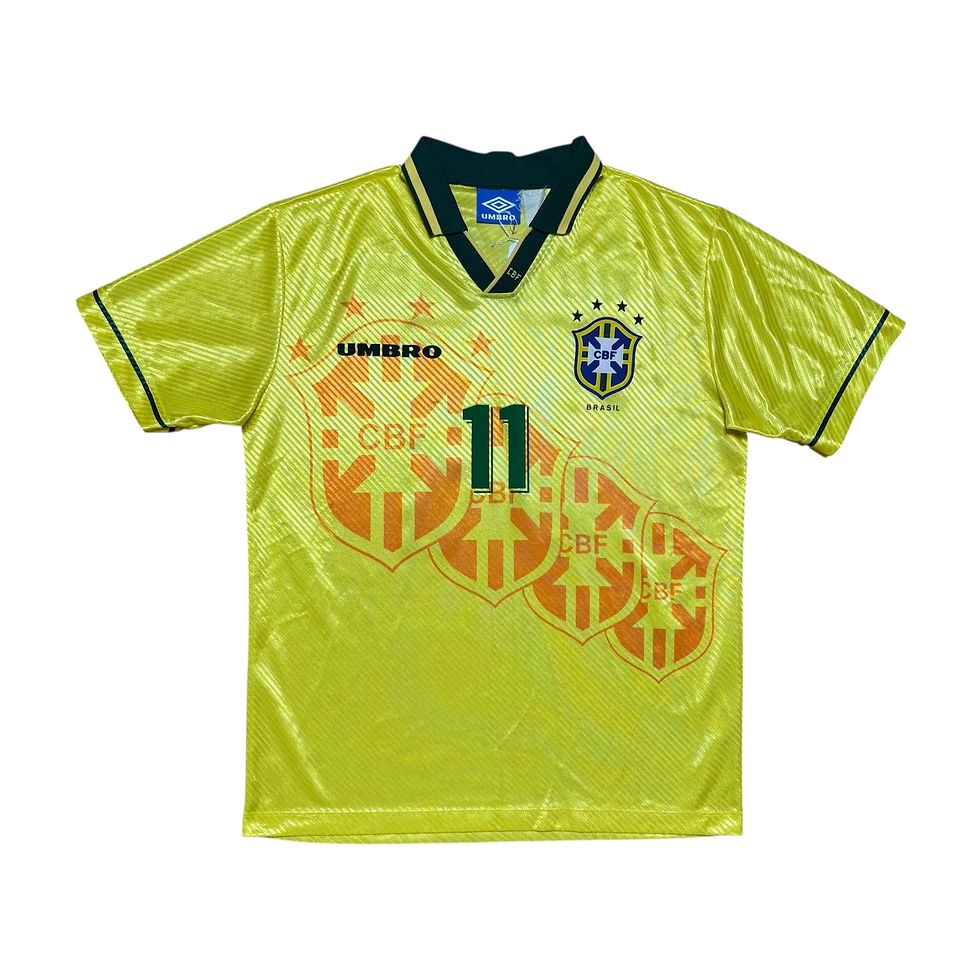
1994-95 – Brazil – Home Shirt – Romário 11 - L

Few football shirts resonate worldwide like the 1994–95 Brazil Home Shirt with Romário’s number 11. It represents more than a moment in football history—it embodies one of the most iconic eras of the Seleção and a period in which Romário stood at the very peak of the sport. Produced by Umbro, the design remains among the most recognisable ever worn by Brazil, connected forever to the country’s return to the summit of world football.
The years 1994 and 1995 marked a high point for Brazilian football. In the summer of 1994, Brazil ended a 24-year wait by winning the FIFA World Cup in the United States. No player was more important to that triumph than Romário. Wearing number 11, he produced a series of brilliant performances, scoring decisive goals and leading Brazil with exceptional skill and composure. His contributions earned him the Golden Ball as the tournament’s best player, and later the FIFA World Player of the Year award. When Brazil entered the 1994–95 cycle, Romário remained the team’s most influential attacking figure.
The squad around him was filled with quality. Bebeto partnered Romário with intelligence and chemistry, while Dunga provided steel and leadership in midfield. The defence, anchored by Jorginho and Aldair, offered balance, and Taffarel gave stability in goal. As world champions, Brazil participated in numerous international matches, from high-profile friendlies to competitive fixtures such as Copa América 1995. Throughout these games, the team’s style reflected both confidence and discipline, and Romário remained their decisive attacking force whenever he played.
The shirt worn during this period carries enormous symbolic value. The bright canary yellow, the green geometric patterns and the traditional collar created a design that instantly evokes memories of the 1994 victory and the celebrations that followed. When paired with Romário’s number 11, the shirt becomes even more iconic, representing the golden moment when Brazilian football reclaimed its throne.
Collectors treasure shirts from this period because they represent both cultural significance and football excellence. The 1994–95 home shirt is associated with joy, pride and the artistry that defines the sport in Brazil. It also captures Romário’s career peak—a time when he combined instinctive finishing, dazzling ball control and clinical movement to dominate world football. An original shirt in size L and in very good condition is particularly desirable due to its rarity and historical depth.
For fans, the emotional value of this shirt is profound. It recalls moments of global celebration, legendary performances and the rekindling of Brazil’s footballing identity. It symbolises a blend of talent and charisma that few teams have ever matched. Wearing or displaying the shirt connects supporters to an era defined by creativity, confidence and unforgettable achievements.
Today, the 1994–95 Brazil Home Shirt with Romário 11 stands as a timeless classic—one of the most iconic shirts in football history, linked directly to the brilliance of a player and a team that captured the world’s imagination. For collectors and enthusiasts alike, it remains a powerful artefact of Brazil’s greatest footballing triumphs.
2006-08 – Cameroon – Away Shirt - Eto'o 9 - L

The 2006–08 Cameroon Away Shirt with Samuel Eto’o’s number 9 remains one of the most recognisable and meaningful kits in African football history. Produced by Puma, the shirt represents a period in which Cameroon continued to assert its identity on the international stage while Eto’o solidified his reputation as one of the most feared forwards in world football. For collectors, this shirt embodies both cultural significance and a remarkable footballing legacy.
Between 2006 and 2008, Cameroon’s national team was undergoing transition, blending established leaders with fresh talent. At the centre of the squad stood Samuel Eto’o, already celebrated for his world-class achievements at club level and widely regarded as the continent’s standout attacker. Wearing the number 9, Eto’o carried the responsibility of leading the line in major competitions and qualification campaigns. His pace, precision and clinical finishing made him a constant threat and, during this period, he continued to break records and deliver vital goals for his country.
The 2006 Africa Cup of Nations remains one of the defining tournaments linked to this shirt cycle. Eto’o finished the competition as its top scorer, showcasing his exceptional instincts and demonstrating his importance to the Indomitable Lions. Although Cameroon did not capture the title, their performances reaffirmed the nation’s competitive strength and Eto’o’s unmatched influence. Throughout 2006–08, Cameroon also competed in numerous qualifiers and international fixtures, relying on Eto’o’s leadership and experience in a team supported by key players such as Rigobert Song, Achille Emana, Jean II Makoun and Idriss Kameni.
The away shirt itself is a striking example of Puma’s design philosophy for African federations during the mid-2000s. With its bold colours, athletic fit and distinctive detailing, the shirt reflects both national identity and the vibrancy associated with Cameroonian football. The combination of dynamic graphics and lightweight performance fabric made it instantly recognisable on the international stage. Paired with Eto’o’s number 9, the shirt becomes even more iconic, representing a footballer whose name became synonymous with both elite club success and African pride.
For collectors, shirts tied to major African stars hold enduring appeal, and Eto’o’s influence ensures that this away shirt remains particularly desirable. His achievements at both club and international level, along with his unmatched status in Cameroonian football, mean that original shirts from this period carry strong historical and emotional value. A size L example in very good condition is an attractive find for collectors seeking pieces connected to pivotal moments in African football history.
For supporters, the shirt evokes memories of fierce competition, passionate performances and the unmistakable energy of Cameroon’s national team. It recalls Eto’o’s bursts of speed, his confidence in front of goal and the leadership presence he provided throughout the squad. The 2006–08 away shirt stands as a visual reminder of Cameroon's footballing identity—dynamic, expressive and fiercely competitive.
Whether displayed as part of a curated collection or kept as a symbol of admiration for one of Africa’s all-time greats, the Eto’o 9 Cameroon Away Shirt from 2006–08 remains a timeless and culturally significant piece of football heritage.

2003-04 - Italy - Home Shirt - Del Piero 7 - L

The 2003–04 Italy Home Shirt with Alessandro Del Piero’s number 7 is a memorable piece of Azzurri history, representing a period of transition and preparation rather than major tournament play. Produced by Puma, the shirt introduced a modern, athletic aesthetic to Italy’s kit identity, and while it was not the design worn at Euro 2004, it became closely associated with Italy’s build-up and friendly fixtures leading into the competition. For collectors, this distinction adds unique historical value.
By 2003–04, Alessandro Del Piero had already established himself as one of Italy’s defining players. After years of excellence with Juventus and key contributions to the national team, he remained a vital attacking threat and a symbol of elegance and loyalty. Wearing number 7, he played an important role in Italy’s friendly matches, qualification games and team evolution during this period. His creativity, set-piece quality and leadership ensured he stayed at the centre of Italy’s attacking identity.
The Azzurri squad at the time blended world-class experience with emerging talent. Paolo Maldini, nearing the end of his international career, continued to provide remarkable consistency and leadership. Fabio Cannavaro and Alessandro Nesta formed one of the most respected defensive pairings in football, while Gianluigi Buffon further cemented his status as Italy’s long-term first-choice goalkeeper. In midfield, players like Gattuso and Pirlo were beginning to shape the future style of the national team, balancing intensity with technical excellence. Up front, Totti and Del Piero remained the creative heartbeat of Italy’s offence.
The 2003–04 home shirt stood out due to Puma’s innovative design. It introduced a tighter fit, refined stitching and subtle visual elements that modernised Italy’s traditional blue identity. The shirt represented a shift toward performance-focused football apparel while preserving the elegance associated with the Azzurri. When paired with Del Piero’s number 7, the design gains additional emotional resonance—connecting supporters to a player who embodied class, loyalty and versatility.
Although this shirt was not the one used at Euro 2004, it occupied a meaningful place in the national team’s timeline. It served as the kit Italy as worn during preparation for the tournament, appearing in qualification matches and friendly fixtures where tactical experimentation and squad adjustments took place. For collectors, shirts from non-tournament periods often hold special appeal because they represent overlooked but essential chapters in a team’s development.
Today, the 2003–04 Italy home shirt with Del Piero 7 remains sought after due to its clean design, association with one of Italy’s greatest players and its place in a transitional era leading to the successes later achieved in the mid-2000s. In size L and in very good condition, it stands as a display-worthy piece of Azzurri heritage.
Whether framed, collected or worn with pride, this shirt symbolises the elegance of Italian football, the enduring excellence of Alessandro Del Piero and the evolution of the national team during a key pre-tournament phase.

2006-08 - Italy - Away Shirt - Cannavaro 5 - M

The 2006–08 Italy Away Shirt with Fabio Cannavaro’s number 5 stands as one of the most iconic pieces of Azzurri memorabilia, representing a period defined by extraordinary success, national pride and the brilliance of one of the greatest defenders in football history. Produced by Puma, the shirt is closely tied to the years surrounding Italy’s 2006 World Cup triumph and reflects the era in which Cannavaro reached the absolute peak of his career.
The 2006 World Cup remains one of the most celebrated achievements in Italian football. Serving as captain, Cannavaro led the team with unmatched composure, timing and defensive intelligence. He delivered one of the finest individual tournament performances ever recorded, inspiring Italy through every round and playing every minute without receiving a single card. His dominance in the air, anticipation of danger and calm distribution under pressure made him the backbone of a team built on tactical balance and mental resilience. At the end of 2006, Cannavaro was awarded the Ballon d’Or, becoming only the third defender in history to win the award.
The 2006–08 cycle saw Italy continue into friendly fixtures, Euro 2008 qualifiers and pre-tournament preparations while wearing this away shirt. Although the World Cup itself used a specific tournament model, the 2006–08 Puma design remained the standard away kit for most matches between major competitions. Across these fixtures, Cannavaro continued to provide leadership alongside other pillars of the squad: Buffon in goal, Pirlo orchestrating the midfield, Gattuso supplying intensity, and Del Piero offering experience and technical quality.
The shirt design reflects Puma’s modern approach of the time—sleek, athletic and shaped to enhance performance. The crisp white base combined with subtle blue and gold accents created an elegant look that preserved Italy’s traditional identity while modernising its aesthetic. When paired with Cannavaro’s number 5, the shirt becomes an immediate symbol of the era’s defensive excellence and Italy’s golden moment on the world stage.
For collectors, this shirt holds immense appeal. Items associated with Italy’s 2006–08 period remain highly sought after, not only because of the World Cup victory but because of the stability and identity the team carried into the following years. Cannavaro’s leadership and global recognition add another layer of desirability. An authentic 2006–08 away shirt in size M and very good condition offers both historical and emotional value.
The emotional connection to this shirt extends beyond aesthetics or results. For many supporters, it represents unity, determination and the resilience Italy showcased during a complex and dramatic World Cup. It reflects a football culture that values tactical intelligence, discipline and the ability to rise to the occasion. Cannavaro’s performances became symbolic of these qualities—he was the anchor, the leader, the calm presence that guided Italy to glory.
Whether displayed as part of a curated collection, preserved as a symbol of national pride or worn to celebrate football heritage, the 2006–08 Italy Away Shirt with Cannavaro 5 remains a timeless reminder of a legendary era. It recalls a captain at his peak, a squad that conquered the world and a period in which Italian football stood at its very best.

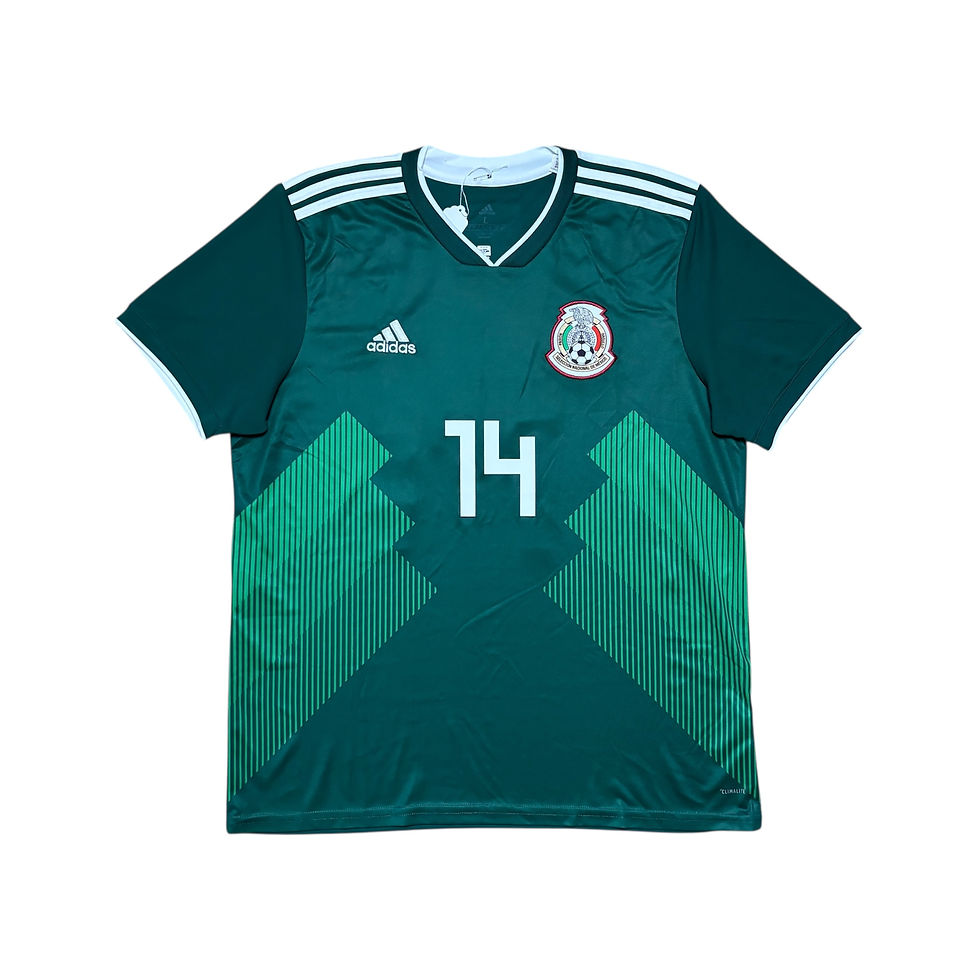
2018-19 - Mexico - Home Shirt - Chicharito 14 - L

The 2018–19 Mexico Home Shirt with Chicharito’s number 14 is a modern classic that captures the emotion, pride and footballing identity of El Tri during one of the most memorable cycles in recent national team history. Produced by adidas, the design draws inspiration from Mexico’s iconic 1990s kits while embracing a contemporary, performance-focused silhouette. For fans and collectors alike, this shirt represents the energy of the 2018 World Cup and the continued legacy of Javier “Chicharito” Hernández.
Chicharito entered the 2018 World Cup as Mexico’s all-time leading scorer, and his influence remained central to the squad. Wearing number 14, he scored in the group-stage win over South Korea, a goal that both sealed the victory and reaffirmed his reputation as one of Mexico’s greatest forwards. His movement, instinctive finishing and experience made him a vital component of a team that thrived on quick transitions and coordinated attacking play.
The 2018–19 season reflected a transitional moment for Mexico, combining World Cup veterans with an exciting new generation. Hirving Lozano emerged as one of the standout young talents on the world stage, while Andrés Guardado and Hector Herrera continued to anchor the midfield with intelligence and leadership. Guillermo Ochoa remained a key figure between the posts, delivering the shot-stopping consistency that has long made him a national favourite.
The shirt itself plays a major role in its lasting appeal. The green base, accented with white and red tonal elements, pays homage to classic Mexican kits worn throughout the 1990s. adidas enhanced the design with modern detailing and a clean collar, producing a shirt that felt both nostalgic and fresh. Supporters embraced it quickly, and it became one of the most recognisable and celebrated designs of the decade. When paired with Chicharito’s number 14, the shirt gains additional narrative weight, linking it to moments of national celebration and personal achievement.
Beyond the World Cup, the 2018–19 cycle included friendly matches and preparation for upcoming continental tournaments. Chicharito continued to contribute during this period, offering leadership and experience as the team looked toward the future. His presence served as a bridge between generations, connecting the longstanding values of El Tri with the emerging ambitions of a younger squad.
For collectors, this shirt holds particular significance. Shirts tied to major tournaments and iconic national players consistently rank among the most desirable in the market. Chicharito’s status as Mexico’s record goal scorer, combined with the strong visual identity of the 2018–19 shirt, makes this version especially appealing. In size L and very good condition, it stands as both a display-worthy item and a meaningful representation of a beloved era.
To fans today, the shirt evokes powerful memories: the excitement of the 2018 World Cup, the belief in a united national team, and the enduring affection for Chicharito’s passion and commitment. It symbolises pride, tradition and the joy that football brings to millions of Mexican supporters.
Whether added to a curated collection, framed as a tribute or worn to celebrate national identity, the 2018–19 Mexico Home Shirt with Chicharito 14 remains an iconic piece that honours El Tri’s history and one of its greatest players.
2002-04 - Liverpool - Home Shirt - Gerrard 17 - S

The 2002–04 Liverpool Home Shirt with Gerrard’s number 17 marks an important stage in the evolution of both the club and one of its greatest-ever players. Produced by Reebok, the shirt represents a period of growth, ambition and identity building, during which Steven Gerrard transformed from a promising local talent into the heartbeat of Liverpool’s midfield. For collectors and supporters, this shirt encapsulates the start of Gerrard’s rise toward legendary status.
Across the 2002–03 and 2003–04 seasons, Liverpool found themselves in transition. The club possessed a strong core of experienced leaders and emerging stars, blending stability with the promise of future success. Gerrard, still wearing the number 17 shirt he used early in his career, increasingly became the driving force of the team. His tenacity, long-range passing and ability to dominate midfield duels made him indispensable, while his vocal leadership foreshadowed the captaincy he would soon inherit.
The 2002–03 season brought silverware, with Liverpool lifting the League Cup after a disciplined run that highlighted the team’s quality and resilience. Gerrard played an impactful role throughout the competition, contributing significantly in midfield and displaying the competitive edge that would define his career. Liverpool also competed in the UEFA Cup, Premier League and domestic cups, pursuing success on multiple fronts under Gérard Houllier’s management.
The squad during this period was rich with notable talent. Michael Owen, the reigning Ballon d’Or winner at the start of the cycle, continued to deliver crucial goals. Sami Hyypiä offered leadership and aerial strength in defence, while Carragher provided versatility and consistency. In midfield, alternatives such as Hamann and Murphy complemented Gerrard’s energetic style, and in 2003 the arrival of Harry Kewell added another dimension to the team’s attacking options.
The shirt’s design holds a special place in Liverpool’s kit history. Featuring a bold red base, a structured collar and Reebok’s minimalist detailing, the 2002–04 home shirt is remembered for its clean look and strong association with early-2000s Liverpool identity. When paired with Gerrard’s number 17, it becomes even more meaningful, symbolising the years when he transitioned into a dominant Premier League figure and one of the most complete midfielders of his generation.
For collectors, shirts from the early phases of a legendary player’s career often hold elevated significance. Gerrard’s number 17 shirts fall firmly into this category, marking a formative era before he adopted the iconic number 8. Their connection to a trophy-winning season, European campaigns and Gerrard’s personal development increases their desirability. In size S and very good condition, this shirt stands as a valuable and authentic piece of Liverpool heritage.
To fans today, the shirt evokes memories of endless drive, lung-busting runs, fearless tackling and Gerrard’s emergence as the leader Liverpool would depend on for more than a decade. It recalls moments of resilience, rebuilding and ambition—an era that laid the foundations for future triumphs and shaped the identity of the modern club.
Whether displayed as a collectible, worn with pride or preserved as part of a curated football shirt collection, the 2002–04 Gerrard 17 home shirt remains a powerful reminder of Liverpool’s history and the rise of one of football’s greatest icons.

2008-10 - Liverpool - Home Shirt - Gerrard 8 - L

The 2008–10 Liverpool Home Shirt with Steven Gerrard’s number 8 stands as one of the most iconic shirts of the club’s modern era. Produced by adidas, the design is instantly recognisable for its clean red styling and gold-trimmed details, but its deeper significance comes from its connection to a period when Gerrard delivered some of the finest football of his career and Liverpool challenged at the highest levels of English and European competition.
The 2008–09 season, which falls within this shirt cycle, is often remembered as one of Liverpool’s best Premier League campaigns prior to the title-winning era under Jürgen Klopp. The team finished 2nd, recording an outstanding points tally and pushing Manchester United all the way in the title race. Liverpool combined tactical intelligence with attacking flair, and much of this success stemmed from the remarkable partnership between Gerrard and Fernando Torres. Gerrard, wearing number 8, frequently operated in an advanced midfield role, contributing goals, assists and match-winning performances. His influence during this period led to his being named the Football Writers’ Association Footballer of the Year in 2009—one of the highest individual honours in English football.
The squad around him was exceptionally strong. Xabi Alonso provided creativity and control from deep midfield, Mascherano offered ball-winning ability and intensity, and Carragher delivered consistent leadership in defence. Kuyt contributed tireless work on the flanks, while Pepe Reina remained one of Europe’s most reliable goalkeepers. Together, these players created a team capable of beating any opponent, and they delivered unforgettable victories, including emphatic wins in major rivalry fixtures that remain celebrated by supporters today.
The 2008–10 home shirt became a visual marker of this era. Its classic red base combined with subtle detailing created a look that felt both modern and faithful to Liverpool tradition. The gold accents added a touch of prestige, reflecting the ambition and stature of the club at the time. When paired with Gerrard’s number 8, the shirt embodies the spirit of leadership, passion and excellence that defined his role within the team. These seasons showcased Gerrard at his dynamic best—driving forward from midfield, scoring spectacular goals and lifting the team through moments of adversity.
For collectors, this shirt holds significant appeal. It is associated with one of the strongest Premier League-era Liverpool sides and with the peak years of one of the club’s greatest-ever players. In size L and very good condition, it is both wearable and display-worthy. The combination of iconic design, historic team performances and Gerrard’s individual accolades ensures its status as a sought-after piece of memorabilia.
For supporters, the emotional connection to this shirt is powerful. It recalls a period of hope, excitement and belief, fuelled by dramatic matches, elite talents and the unmatched drive of Steven Gerrard. The shirt symbolises resilience, ambition and the identity that Liverpool carried into every competition.
Whether displayed proudly in a collection, cherished as a keepsake or worn as a tribute to one of football’s finest midfielders, the 2008–10 Liverpool Home Shirt with Gerrard 8 remains a timeless piece of club heritage.

Conclusion
Taken as a whole, the collection of shirts forms a rich and interconnected tapestry of football history, identity, and emotion. Each shirt encapsulates a moment shaped by iconic individuals, decisive seasons, or shifts in the trajectory of clubs and national teams. Together, they reveal how football shirts serve as tangible anchors of memory—linking supporters to the players they admired, the teams they followed, and the moments that defined their love for the game.
What stands out across all cases is the central role of human stories. Ronaldo’s Juventus period highlights a player pushing sporting limits even in his mid-30s. Gerrard’s Liverpool years—first as a rising midfielder, later as an established leader—show how a player can become the heartbeat of a club. Del Piero, Romário, Eto’o, Chicharito, Ronaldinho, Beckham—each represents a unique style, cultural impact, and emotional connection to supporters around the world. These shirts crystallise not only performances but personalities, each player leaving a lasting imprint on the aesthetics and identity of the teams they represented.
The shirts also showcase the evolution of football aesthetics: from the boldness of early-90s designs to the streamlined modern looks of adidas and Nike. This evolution mirrors the sport’s globalisation, commercial growth and cultural diversification. Some shirts retain deep classical roots, such as Brazil’s canary yellow or Italy’s azzurro; others break new ground, like Juventus’ off-white away kit or Marseille’s modern reinterpretations of tradition.
Beyond the pitch, these shirts represent broader narratives of club identity. Marseille’s revival, Benfica’s European ambitions, Arsenal’s youth-led transition, Manchester United’s dynastic era, PSG’s artistic flair under Ronaldinho—each story is woven into the fabric of the shirts. They carry emotional weight because they remind supporters of who their club was at a given moment, and who they hoped it would become.
From a collector’s standpoint, this ensemble has undeniable value. Many of these shirts correspond to peak moments for legendary players or to seasons that remain etched in collective memory. They are historical touchpoints—objects through which supporters can revisit goals, atmospheres, rivalries and personal memories. Collecting such shirts is not just preserving fabric; it is preserving heritage.
Ultimately, what unifies this diverse set of shirts is the importance of football as a cultural language. These shirts speak of triumph, reinvention, excellence and passion. They remind us that football is not only played on the pitch but lived through stories, memories and identities. Each shirt here represents a chapter, but together they form a compelling book—one that honours the past while continuing to inspire new generations of supporters.
References
Manchester United 1997–98 and 1998–99 season performance records
Beckham’s role, assists and influence during the Treble era
Squad members and historical context of the 1998–99 campaign
Umbro design elements of late-1990s Manchester United kits
Arsenal 2008–09 season statistics and league finish — 2008–09 Arsenal F.C. season
UEFA Champions League semi-final run — Arsenal in European football
Cesc Fàbregas captaincy information — Cesc Fàbregas biography
2008–09 squad list — Arsenal season archives
SKU reference and shirt model confirmation — specialist football shirt retailers
Real Madrid 2002–03 season league results and final standings
Historical records of Real Madrid’s Centenary year
Squad lists and player appearances for the 2002–03 season
Known details of the 2002–03 Centenary home kit and shirt printing conventions
Collectors’ market observations from specialist vintage football shirt retailers
Manchester United 2002–03 Premier League season results and league title
Manchester United squad and Beckham’s final season details
Historical kit usage for the 2002–03 third shirt
Shirt printing conventions for Beckham 7 during the season
PSG 2001–02 season league position and squad information
Ronaldinho’s arrival at PSG and shirt number history
General match and player performance summaries from the 2001–02 Ligue 1 season
Historical kit design details for PSG’s 2001–02 Nike home shirt
Olympique de Marseille 2017–18 season results and league position
Europa League 2017–18 final appearance and match progression
Florian Thauvin’s 2017–18 individual statistics (goals and assists)
Squad and player contributions from the 2017–18 OM season
Historical details of adidas’ 2017–18 OM home kit design
Olympique de Marseille 2017–18 Ligue 1 season results and league position
UEFA Europa League 2017–18 campaign and final appearance
Luiz Gustavo’s performance statistics and role during the season
Historical kit details for OM’s 2017–18 adidas home shirt
Squad and match contributions from the 2017–18 campaign
Olympique de Marseille 2016–17 Ligue 1 season results and league position
Squad list and key winter signings, including Payet, Évra and Sanson
Player performance summaries (Thauvin, Gomis, Lopez)
Historical training wear details for OM’s 2016–17 adidas range
SL Benfica 2006–07 season league results
UEFA Cup 2006–07 performance and quarter-final qualification
Squad list and player roles for the 2006–07 season
Historical details of the adidas 2006–07 Benfica home kit design
Brazil national team 1994–95 match activity
1994 FIFA World Cup awards and Brazil’s title
Romário’s Golden Ball and FIFA World Player of the Year distinctions
Historical Umbro kit details for Brazil’s 1994–95 home design
Brazil squad composition for the World Cup and Copa América 1995
Cameroon national team activity (2006–08)
Africa Cup of Nations 2006 statistics, including Eto’o as top scorer
Squad composition and key players during the 2006–08 period
Historical design details for Puma’s Cameroon kits of the era
Italy national team activity during the 2003–04 period
Shirt model usage confirmation (not used at Euro 2004)
Italy squad composition and key players of 2003–04
Historical kit details for Puma’s Italy designs of the early 2000s
Italy national team activity during the 2006–08 cycle
2006 World Cup achievements and Cannavaro’s Ballon d’Or
Squad structure and key players of the era
Historical Puma kit details for Italy’s 2006–08 designs
Mexico national team activity during 2018–19
2018 FIFA World Cup performance and goal scorers
Chicharito’s status as Mexico’s all-time top scorer
adidas kit design details for Mexico’s 2018–19 home shirt
Squad composition and key contributors of the 2018–19 cycle
Liverpool 2002–03 and 2003–04 season records
League Cup 2002–03 victory
Squad lists and key contributors across both seasons
Historical Reebok kit design notes for Liverpool’s early-2000s shirts
Steven Gerrard’s shirt number history and career progression
Liverpool 2008–09 and 2009–10 season records
Steven Gerrard’s individual honours, including 2009 FWA Footballer of the Year
Key squad roles and contributions from Torres, Alonso, Mascherano and others
adidas design details for Liverpool’s 2008–10 home kit
Juventus 2019–20 Serie A season results and title win
Ronaldo’s 2019–20 scoring records and performances
Squad contributions from Dybala, Higuaín, De Ligt and others
adidas design details for Juventus’ 2019–20 away shirt
Juventus domestic and European campaign summaries
Shop the shirts featured in this article:


Comments